How Slot Volatility Patterns Guide the Strategic Rollout of No-Deposit Rewards Across New Mobile Platforms
Drew Reed · Sep 7, 2026

How Slot Volatility Patterns Guide the Strategic Rollout of No-Deposit Rewards Across New Mobile Platforms
Slot volatility patterns shape how operators distribute no-deposit rewards on emerging mobile platforms because volatility directly influences player retention metrics and bonus redemption rates. Low-volatility slots produce frequent small wins that encourage extended sessions while high-volatility titles deliver larger payouts at lower frequencies. Data from multiple jurisdictions shows that platforms launching in 2025 and 2026 adjust reward structures according to these patterns to match regional player behavior and regulatory expectations.
Operators track historical spin outcomes and payout frequencies before releasing no-deposit credits on new apps. September 2026 marks several scheduled platform expansions in North America and Asia where volatility mapping precedes bonus campaigns. Those expansions rely on aggregated session data that reveals how different volatility tiers affect average playtime after free credit activation.
Understanding Volatility Categories in Mobile Slot Environments
Volatility falls into three primary categories that developers and operators quantify through return-to-player variance calculations. Low-volatility games maintain tight payout distributions with most wins falling between 20 and 50 times the stake. Medium-volatility titles spread returns across a wider range while high-volatility slots produce occasional multipliers exceeding 500 times the initial bet. Mobile platforms record these distributions at the game level so marketing teams can align no-deposit reward sizes with expected hit frequencies.
Research conducted by the University of Nevada Reno Gaming Innovation Lab demonstrates that low-volatility slots paired with small no-deposit bonuses generate higher completion rates for wagering requirements than high-volatility pairings. The study examined over 2.3 million mobile sessions across five platforms and found that players using low-volatility titles completed 68 percent of bonus terms compared with 41 percent on high-volatility titles under identical conditions.
Data-Driven Alignment of Rewards and Volatility
Platform teams compile volatility heatmaps that plot game titles against average session length after no-deposit activation. These maps guide the sequence in which rewards roll out to new user cohorts. Early-stage rollouts often prioritize low-volatility titles because they reduce the chance that players exhaust free credits without experiencing any wins. Later phases introduce higher-volatility options once retention models predict that players will continue depositing after the initial bonus period ends.
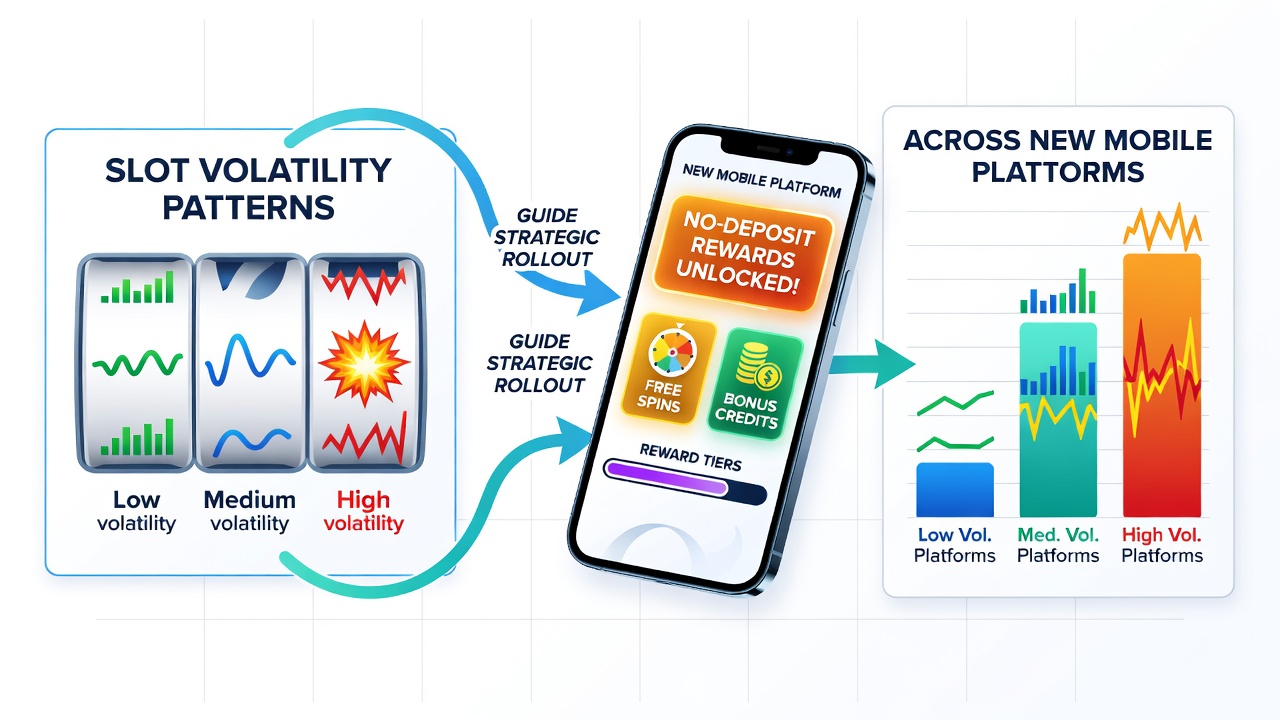
Figures released by the Malta Gaming Authority indicate that mobile operators in the European Economic Area adjusted no-deposit reward sizing by an average of 14 percent in 2025 after implementing volatility-based segmentation. The adjustments correlated with a measurable drop in bonus abuse cases and a corresponding rise in first-deposit conversion rates. Australian regulatory data collected by the Australian Communications and Media Authority shows similar patterns among platforms that entered the market during the same period.
Platform Launch Sequences and Regional Variations
New mobile platforms typically follow a three-phase rollout that maps reward types to volatility profiles. Phase one deploys low-volatility slots with modest no-deposit credits to establish baseline engagement. Phase two expands the catalog to include medium-volatility titles while increasing reward amounts for users who have already met minimum play thresholds. Phase three releases high-volatility options alongside targeted no-deposit offers calibrated to predicted lifetime value scores.
European Gaming and Betting Association reports highlight that operators in regulated markets coordinate these phases with responsible gaming tools that display volatility labels at the point of bonus selection. Players receive clear information about expected win frequency before they accept no-deposit credits on any given title. This transparency requirement has prompted platforms to embed volatility indicators directly into their mobile interfaces rather than relying solely on external game descriptions.
Conclusion
Volatility pattern analysis now forms a core component of mobile platform strategy for no-deposit reward distribution. Operators combine session-level data with regulatory guidelines to time the release of different volatility tiers across user segments. The approach produces measurable differences in redemption rates, session duration, and subsequent deposit behavior across markets that have adopted these methods since 2025.